Botón de oro
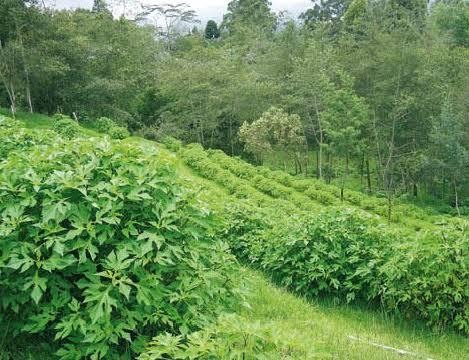
Tithonia diversifoliaA tropical forage shrub with potential to provide protein in ruminant diets. Its nutritional quality depends on regrowth age, growing conditions and the proportion of leaves to stems harvested.

This is a working cattle farm. Farm life, hospitality and forest are all part of the same story.
On this land, Baltazar Fernández and Mariano Guardia began a family farming tradition. The farm returned to the family in the late 1990s and today brings together cattle, rural tourism and conservation.

This is a working cattle farm. Farm life, hospitality and forest are all part of the same story.
Meet our Simmental cattle, commercial Simmental and the progress of our Simbrasil breeding program.
See the programAlongside cattle, we protect the mountain forest next to Tapantí and monitor wildlife with camera traps. Explore the conservation project
NAMA Ganadería is Costa Rica’s initiative to make cattle farming more productive, reduce greenhouse gas emissions and help farms adapt to climate change. NAMA stands for Nationally Appropriate Mitigation Action.
Healthier pastures, more resilient farms, and a smaller climate footprint.
A Sistema Agroforestal (SAF) integrates trees with crops or livestock production. On a cattle farm, living fences are one way to put this into practice: trees form the boundaries between paddocks while contributing to the surrounding ecosystem.
Through its Pago por Servicios Ambientales (PSA) program, FONAFIFO — Fondo Nacional de Financiamiento Forestal can financially recognize eligible agroforestry systems for the environmental services they provide, subject to the program’s requirements and an approved agreement.
Finca Queverí won PROCOMER’s Cultiva+ with an initiative to explore producing supplementary cattle feed from forages grown on the farm. The project is currently at the proof-of-concept stage, where we are evaluating the production process, nutritional quality, preservation and acceptance by the animals.
We are exploring how to turn Mexican sunflower (botón de oro) and nacedero into a practical, storable supplement for cattle. The proposal combines local forage production, harvesting leaves and shoots, pre-processing, solar drying with biogas heat support, and pelleting.
The proof of concept aims to test the feasibility of this process and determine how to preserve nutritional quality, achieve good acceptance by the animals and assess its costs.
Evaluate the protein contribution and quality of the supplement.
Evaluate a product that can be stored and used later.
Explore the use of the farm’s forages and energy resources.
A tropical forage shrub with potential to provide protein in ruminant diets. Its nutritional quality depends on regrowth age, growing conditions and the proportion of leaves to stems harvested.
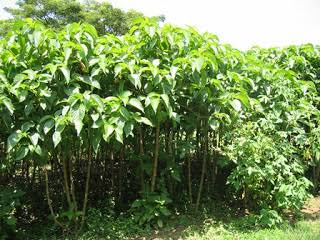
A forage plant used in animal feeding. We will evaluate its yield and nutritional contribution, as well as its acceptance by cattle after drying and processing.
The nutritional values and palatability of the final product will be verified through laboratory analysis and on-farm trials.
We grow botón de oro and nacedero to evaluate their adaptation to farm conditions, regrowth capacity and production of usable material.
We will first evaluate each plant separately and then the mixtures. Feeding trials will be part of a formulated diet with professional bovine nutrition support.
Drying removes water and reduces the material’s weight; it does not create protein. That is why we will measure both nutritional composition and the amount of dry matter recovered.
We are evaluating a supplement to complement the cattle’s diet. Its use will depend on its composition and the animals’ nutritional needs.
Both have potential as protein forages. The content of the batches grown on the farm and of the final product will be determined through analysis.
Acceptance may vary with the animal, its adaptation and the processing. The supplement’s palatability will be part of the proof of concept.
We want to evaluate a combination of energy sources to remove moisture and support drying when solar radiation drops.
We aim to make handling and storage easier. We will compare their advantages and costs against unpelleted dry material.
The project is at the proof-of-concept stage. We will share results once they have been measured and verified.
Cultiva+ recognises this initiative by Finca Queverí. The proof of concept will now let us evaluate how to turn local forages into a supplementary feed alternative and guide the next steps with evidence.